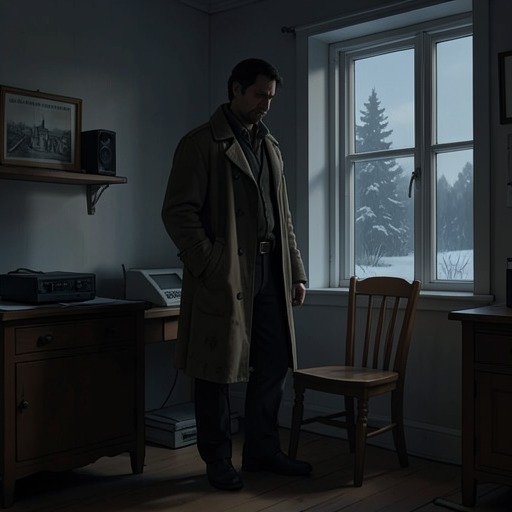
“Things have happened here.”
All My Puny Sorrows“Things have happened here.” is both a declaration of historical attention and, in retrospect, a phrase shadowed by the Von Riesen family’s private history. Jake Von Riesen first uses it to protest public indifference to Canada’s past; as Yolandi Von Riesen recounts the family’s losses and the violence behind its silences, the words widen beyond national history to include what has happened within a family and a community.
A claim for Canadian history
Jake’s attachment to the phrase emerges through his plan to sell Canadian history placemats to truck-stop restaurants. He had designed and printed thousands, presenting historical facts in cartoons, with jokes and riddles intended for adults and children. The project reflected his frustration with people who passed historical plaques, dismissed Canadian-content rules, failed citizenship tests, or misremembered the national anthem. Against that indifference, his refrain insists that the country has a history worth noticing.
The phrase also belongs to Jake’s sense of civic and personal connection. Between Christmas and New Year’s, at thirty-seven, he travelled by train to Ottawa to research in government archives and attend Lester B. Pearson’s funeral. Outside the legislative building, he spoke with a stranger who invited him to a New Year’s Eve party. When Jake later told the family about the state funeral and the unexpected welcome, Yolandi remembered the hush that fell over them and sensed that her father had lost a leader and needed a friend. His historical interest was not merely a sales pitch: it was bound up with a longing for shared belonging and recognition.
The history carried in silence
The family phrase acquires a darker dimension against the history Yolandi narrates elsewhere. Her grandparents came from a Mennonite village in Siberia, and the family’s past includes murder, forced displacement, and survival. Her paternal grandfather survived by hiding in manure after his parents were killed; he was later transported to Moscow and sent to Canada. He warned Jake and Lottie not to teach their children Plautdietsch if they wanted them to survive. The language became associated with shame and with a learned practice of shouldering pain without speaking of it.
That silence is not an absence of history. Yolandi describes suffering as something that can pass from one generation to another, while her grandfather’s memories of slaughter remain present even when he smiles. In this context, “Things have happened here.” can be read alongside a family history that has happened on several continents and continues to shape life in Canada. The phrase’s plainness holds open the difference between publicly acknowledged history and inherited experience that has been difficult to name.
From civic refrain to family reckoning
Yolandi’s later reflections sharpen the phrase’s implication. While thinking about the community’s condemnation of her family, she rejects the idea that inherited persecution excuses intimidating or shaming others. Her account connects the elders’ conduct to the history of violence and flight behind the family, but does not treat that history as absolution. The past explains how pain travels; it does not make the harm done in its name harmless.
The phrase therefore does not resolve the novel’s history into a comforting lesson. Jake’s appeal asks people to attend to what has happened in Canada; Yolandi’s narration makes that attention more demanding by showing that history also persists in family language, memory, grief, and silence. What begins as her father’s plea against civic forgetfulness becomes a frame for recognizing that the past is present even when a family has learned not to speak it.